Squizzy Taylor’s bent spoon
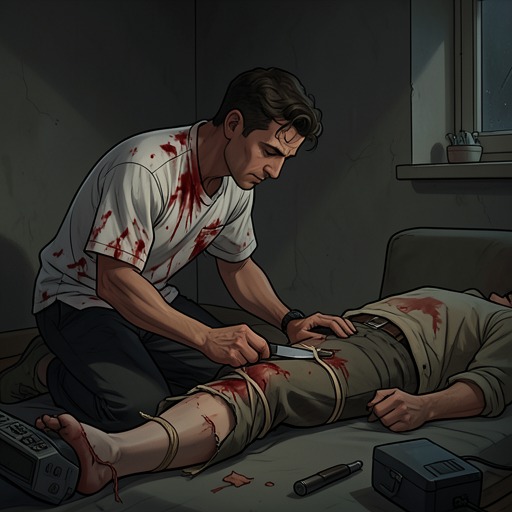
The Narrow Road to the Deep NorthSquizzy Taylor’s bent spoon is an improvised surgical tool whose importance lies in the gap between a workable idea and an uncertain outcome. When ordinary control of the bleeding is no longer available, Taylor proposes using the spoon to press on the femoral artery while Dorrigo Evans operates. Its temporary success helps make the operation possible, but the renewed emergency reveals that neither the tool nor the procedure can secure Jack Rainbow’s survival by itself.
An Improvised Instrument
The spoon enters the scene through a practical problem: the injury is too high on the leg for a tourniquet to be placed above it. Taylor is not a surgeon, and the passage presents him as reasoning through a physical constraint rather than applying formal medical authority. He locates the femoral artery by pressing his fingers into his own groin, testing where pressure might reduce the blood flow enough for Dorrigo to work.
Taylor’s proposal is tentative. A round, flat object might compress the artery; a spoon with its handle bent around might serve. The spoon is not introduced as purpose-made equipment, but as an ordinary object reshaped in thought for an immediate need. Its significance depends on a precise action: holding pressure at the artery while Dorrigo removes the stump, clamps the arteries, and sutures. The improvised tool does not replace the surgeon’s work. It is meant to buy the time and control that work requires.
A Tool Shared Between Men
The spoon’s use makes the operation a coordinated effort. Taylor supplies the idea and maintains pressure; Dorrigo has to work quickly, then carefully, while that pressure is held. Once the bleeding stops and Dorrigo has sutured the artery, he tells Taylor, “Spoon away, Major. Gently.” Taylor lifts it, and Dorrigo continues preparing the muscles and skin flap to cover the bone stump.
That exchange marks a brief change in what the spoon can do. At first it is only a possible answer to an anatomical problem; during the operation, it becomes part of the practical arrangement that lets Dorrigo proceed. Its removal is controlled, not abrupt: Dorrigo asks for it to be taken away gently, and Taylor complies. The action suggests that pressure has become unnecessary after the artery is sutured, though the improvement remains provisional. Dorrigo recognizes that recovery and infection are still concerns, even as he judges Rainbow’s chances good.
The Return of the Emergency
The reprieve does not last. Blood begins to appear again as the stitched flaps swell and the earlier seepage becomes persistent. Taylor identifies the likely explanation: the sutures holding the femoral artery together may have given way. Dorrigo freezes momentarily, then calls for the spoon. Its return is not a second, independent use of an improvised aid; it is an attempt to restore the pressure that had supported the first phase of the operation.
This time, the conditions are harder. Rainbow’s body convulses, and Taylor cannot keep the spoon pressed against it. Jimmy Bigelow switches on the torch to resume his position, but the light dims and goes out. Dorrigo calls for both the spoon and light as the body continues to move. The object’s usefulness is therefore shown to depend not only on its shape, but on a person’s ability to hold it in place amid a rapidly deteriorating procedure. The available evidence leaves the operation at this crisis; it does not establish whether the renewed attempt succeeds.
Narrative Significance
The spoon gives a small, concrete form to the scene’s unstable balance between skill and contingency. Dorrigo’s surgical knowledge matters, but the operation also depends on Taylor’s improvised solution, his sustained pressure, and the light Jimmy provides. When the spoon is lifted, the bleeding appears controlled; when it must be used again, bodily movement defeats the pressure it was meant to apply. The same object thus accompanies both a moment of hope and the return of danger.
Its ordinary character sharpens that contrast without making it a symbol detached from the action. The spoon matters because of what it can physically do in this emergency, and because its limits become visible when the circumstances change. It helps the men act, but cannot guarantee the result. By leaving the renewed crisis unresolved in the supplied scene, the narrative preserves the difference between a temporary technical success and a secure rescue.